
The Fed Crashes The Stock Market!
Interest rates are back on everyone’s mind.
The Federal Reserve Bank (the Fed) met last Wednesday to discuss what to do with interest rates.
It was a very important meeting because the Fed has a new chairman.
Kevin Warsh replaced Jerome Powell at the end of May, and last week’s Fed decision was the first big test for Warsh as chairman.
Warsh was selected by President Trump partly because of Warsh’s willingness to lower interest rates.
But it didn’t go according to plan.
The Fed announced interest rates won’t change, and the stock market freaked out.
The Dow dropped over 1,100 points on Wednesday, making it the biggest drop since the tariff crash in April 2025.
Why did the stock market crash?
Interest rate decisions are made by the 12 members of the Federal Open Market Committee, with Warsh being one of the members.
Nine members voted to keep rates the same, while three voted to actually increase interest rates.
At the beginning of the year, the idea of raising interest rates was crazy.
But higher inflation, caused by surging oil prices, is worrying the Fed.
And in September, investors think interest rates are going to rise.
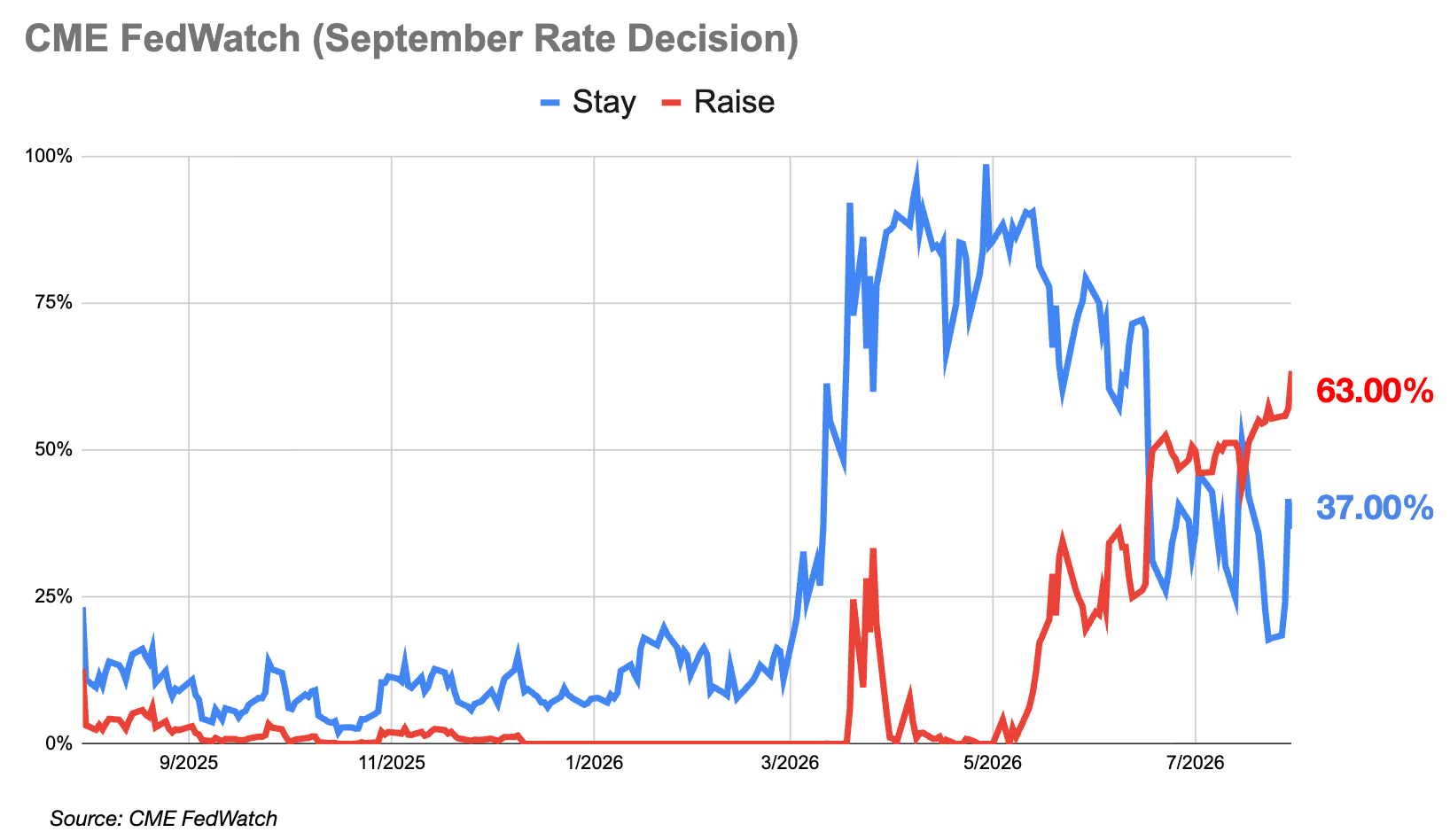
CME Group runs an interesting calculation called the CME FedWatch.
The calculation is complicated, but CME Group gives percentages on what investors think interest rate decisions will be based on futures contracts.
It’s very technical, but here’s the methodology behind the calculation.
The chart shows the chances of a rate increase were essentially nonexistent at the start of the year.
However, since May, the chances of a rate increase have risen to 63%.
Investors were hopeful Warsh could steer the Fed to keep rates steady, or even lower them.
But Warsh’s comments during his press conference were more focused on inflation rather than growth, so interest rate cuts appear to be off the table.
Generally, higher interest rates are bad for the stock market because they slow down economic growth to fight inflation.
What should we do?
If interest rates are about to rise, these stocks are set to benefit.
Business development companies (BDCs) make a lot of money with high interest rates.
BDCs are similar to banks because they lend money to small businesses.
However, rather than using customer deposits like a bank, BDCs borrow money to lend out.
BDCs borrow money at fixed rates, but lend the money using floating rates, making more money when interest rates are higher.
There are many BDCs to choose from, but Ares Capital (ticker: ARCC) is the biggest and one of the best.
Ares Capital invests and loans out money to more than 600 different companies, giving it a very diversified portfolio.
If one investment defaults, then Ares Capital doesn’t lose a significant portion of its income because it works with so many different companies.
Plus, Ares Capital does a great job finding quality companies to lend money to.
The non-accrual rate is the percentage of loans not paying interest, meaning the borrower is having financial difficulty and isn’t making payments.
The BDC industry averages a 4% non-accrual rate, but Ares Capital’s rate is only 2.4%.
And if you’re looking for income, Ares Capital’s 10.25% dividend yield is incredible.
Grocery stores don’t directly benefit from higher interest rates.
But if the economy suffers, then consumers’ tighter wallets will move their eating from restaurants to cheaper, home-cooked meals.
Kroger (ticker: KR) is the largest supermarket retailer in the US with almost 3,000 locations.
Kroger’s return on equity (ROE) of 14% is one of the highest among grocery retailers.
And its forward price-to-earnings ratio (P/E), which uses next year’s earnings, is only 11x, so we’re getting the grocery retailer at an excellent price.
Higher interest rates mean savers make more money.
Most of us think about it with regard to personal finance, but the same principle applies to companies.
Companies with high cash reserves will be making more interest income from higher rates.
And nobody has more cash than Berkshire Hathaway (ticker: BRK.A / BRK.B).
Berkshire Hathaway, formerly run by famed investor Warren Buffett, is a conglomerate with operations primarily in insurance, transportation, and manufacturing.
Last quarter, the company had almost $400 billion in cash and equivalents, which will generate billions of dollars in interest every year.
If interest rates rise, so will Berkshire Hathaway’s interest income.
Do you think interest rates are going to rise by the end of the year?
Send me a note with your thoughts!
Coach Parker
Category: Stocks