
Top Software Company Is Too Cheap To Pass Up

The software industry has had a rough time in the stock market recently.
Software stocks are down due to fears of artificial intelligence (AI) stealing their business.
But AI might be overhyped, and one software company is a major deal right now.
Intuit (ticker: INTU) isn’t a household name, but its products are.
Intuit builds and sells popular tax software TurboTax and accounting software QuickBooks.
Many of us use TurboTax to file our taxes.
And many small businesses need QuickBooks to manage their operations and budgeting.
Intuit’s stock price is down almost 50% over the past year.
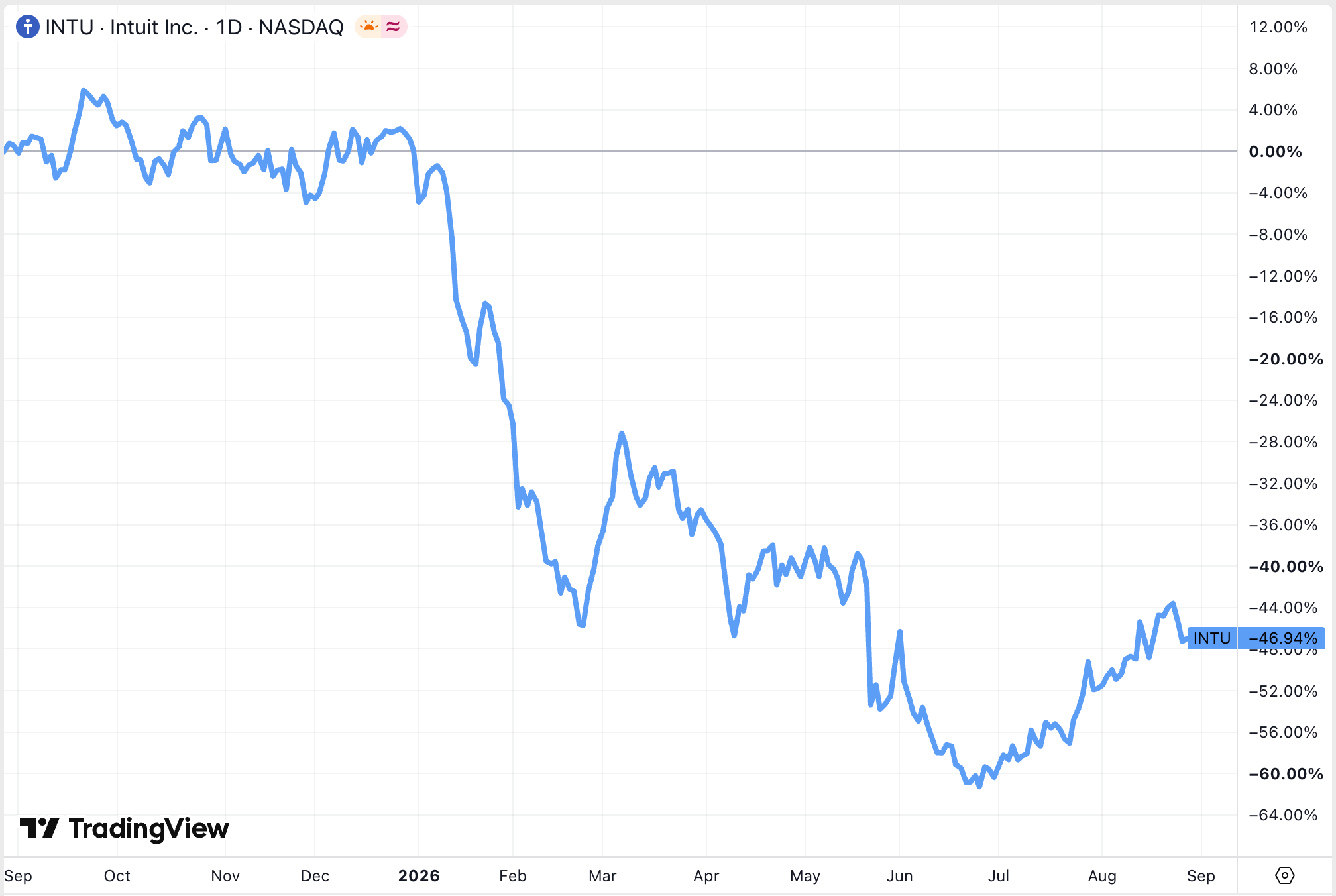
At one point in June, the stock was down over 60%!
It’s not tax season… so why are we talking about Intuit?
Intuit reported earnings last week, and the results were interesting.
For fiscal year 2026, Intuit reported a 14% increase in revenue, which slightly beat analyst expectations.
The real surprise happened with earnings.
Intuit reported an EPS of $4.03, which was 20% higher than last year and more than 10% higher than what analysts expected.
Despite the strong year, Intuit’s stock price dropped over 3% following its earnings release.
The drop occurred because Intuit’s guidance came in lower than expected.
Guidance is management’s projected range of short-term performance for metrics like revenue and EPS.
Intuit’s management expects EPS to grow around 23% next year, but revenue is expected to rise only 9% to 10%.
Investors are nervous about Intuit’s slower revenue growth signaling the start of a downward trend.
However, the stock price drop is ridiculous.
Earnings are still expected to grow by more than 20%, largely from share repurchases and cost savings from workforce reductions.
Plus, Intuit’s operating margin of 29% is one of the highest among software companies and an all-time high for Intuit.
Management also runs Intuit very efficiently with an industry-leading 23.4% return on equity (ROE).
Lastly, Intuit’s valuation ratios show its stock price is incredibly cheap right now.
Its current price-to-earnings (P/E) ratio of 21x is the lowest it’s been since the Great Recession in 2008.
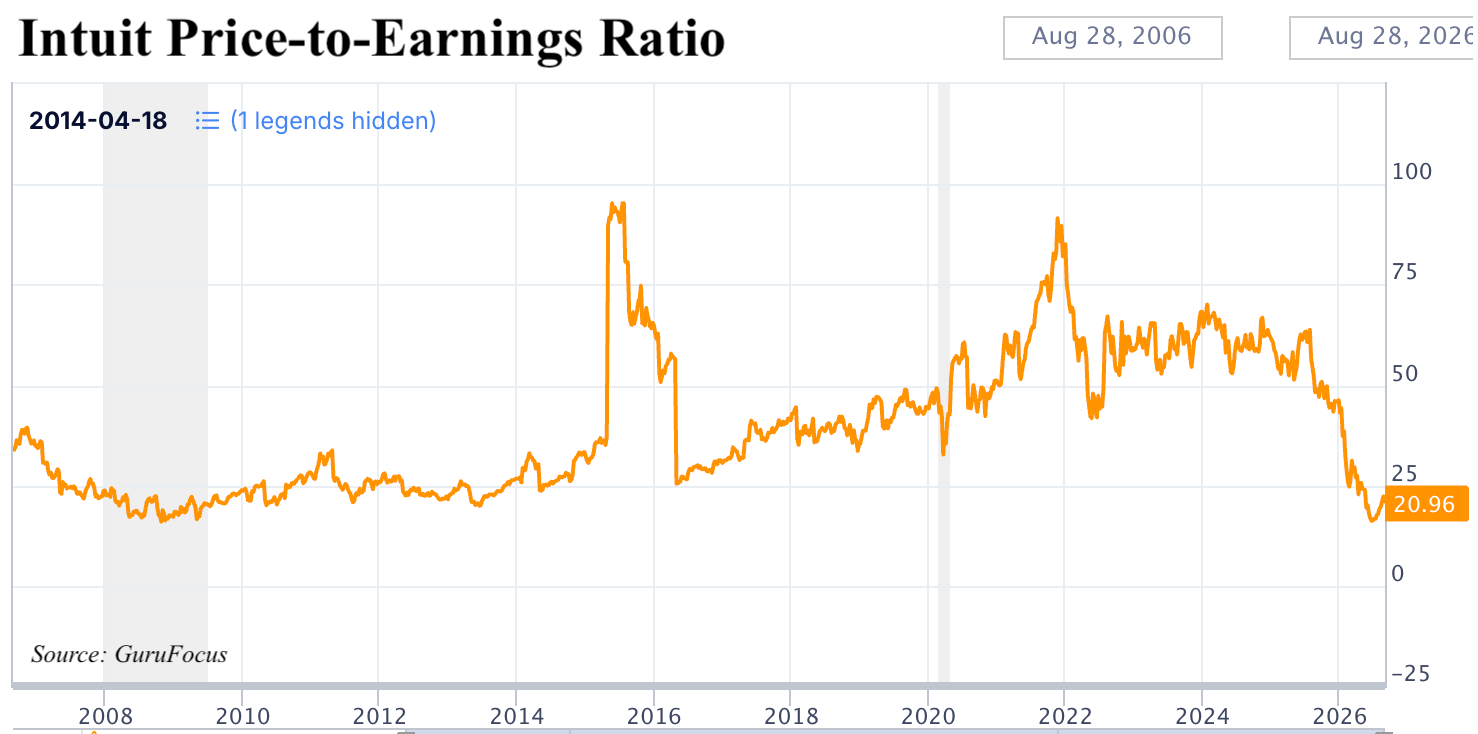
Intuit’s P/E ratio is right in line with other software companies, but P/E ratios don’t account for growth.
Instead, investors should look at the PEG ratio, which is calculated by dividing the P/E ratio by expected earnings growth.
Most software companies’ PEG ratios sit around 1.3x, but Intuit’s is only 0.9x (21x P/E divided by 23% EPS growth).
Now, the elephant in the room is AI.
If people start using AI to help prepare their taxes or manage small business budgeting, then Intuit is in a lot of trouble.
But the risk is overblown.
First, while AI is improving, it can still be frustrating to use.
AI still makes frequent errors, and I certainly wouldn’t trust it to do my taxes.
You’d be crazy to dump your income and deductions into AI to produce a tax return for the IRS.
Second, Intuit is already integrating AI into its popular software products.
Intuit Assist is a chatbot developed by Intuit for task automation and user assistance in QuickBooks and TurboTax.
Plus, Intuit provides protection from IRS audits, which is something AI chatbots don’t offer.
People will have far more confidence working with AI within Intuit’s existing software, since Intuit is the expert.
What software companies are on your radar right now?
Coach Parker
Category: Stocks