
Semiconductor Stocks Crash
Semiconductor stocks have been the darlings of the stock market in 2026.
For the first 6 months, the industry had more than doubled and really drove a lot of the stock market gains.
It makes sense since semiconductor chips are in high demand to develop artificial intelligence (AI).
However, once the calendar flipped to July, semiconductors started to crash.
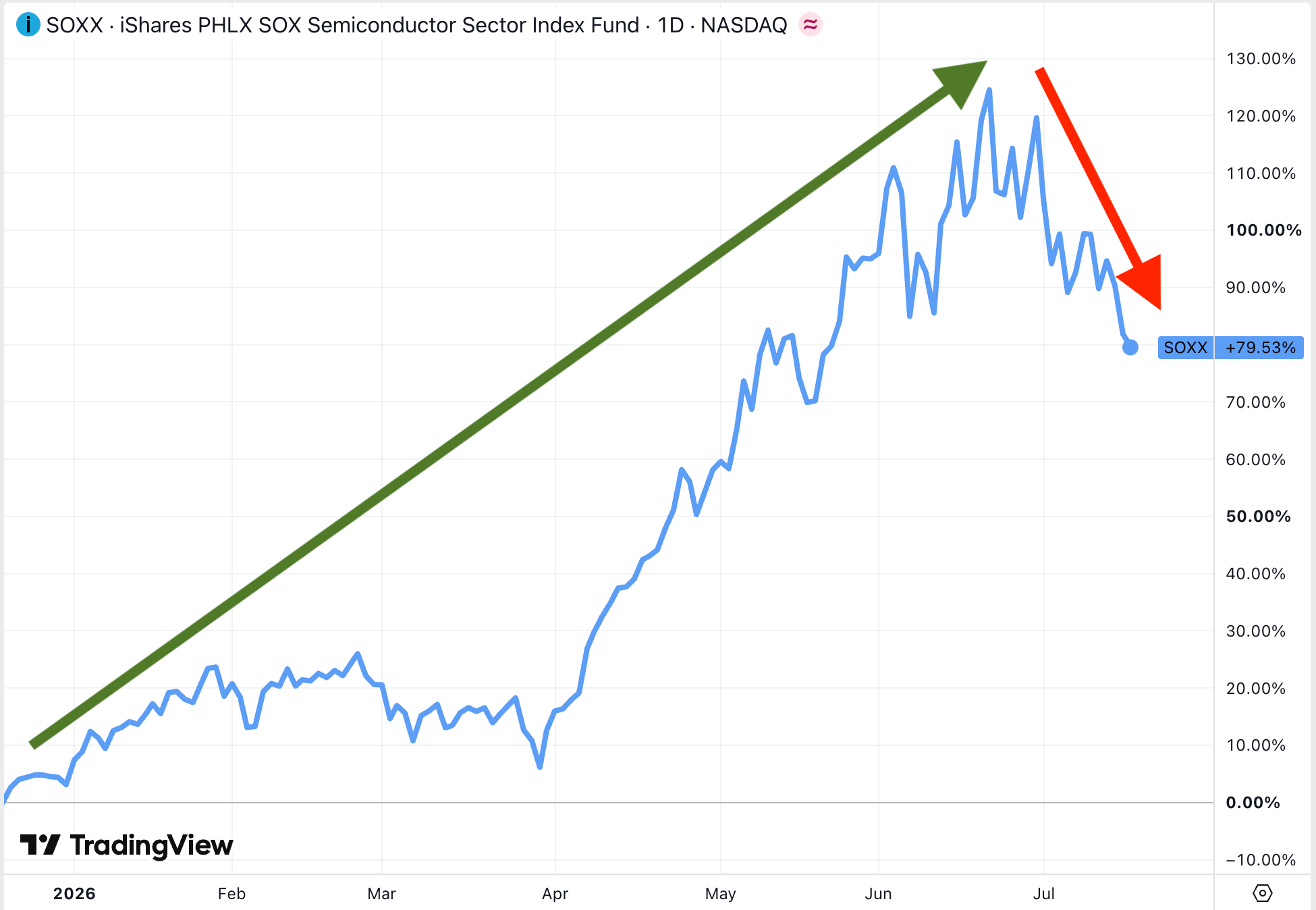
In the last few weeks, semiconductors are down almost 20%, and it’s scaring everyone.
Is the AI bubble starting to pop or is something else going on?
Let’s dig deeper.
While the overall semiconductor industry is down, it’s not all semiconductor stocks.
Nvidia (ticker: NVDA), the biggest semiconductor designer, is actually up about 2% since the beginning of July.
Broadcom (ticker: AVGO), another large semiconductor company, is only down 1%.
And many other AI-focused stocks like Microsoft (ticker: MSFT) and Amazon (ticker: AMZN) are positive over the last few weeks.
So the drop in the semiconductor industry isn’t a sign the AI bubble is starting to pop.
Otherwise, the stocks mentioned above would be performing a lot worse.
If some of the biggest semiconductor stocks aren’t dropping, why is the industry performing so badly in recent weeks?
The chart below has a lot of information, but it’s really important.
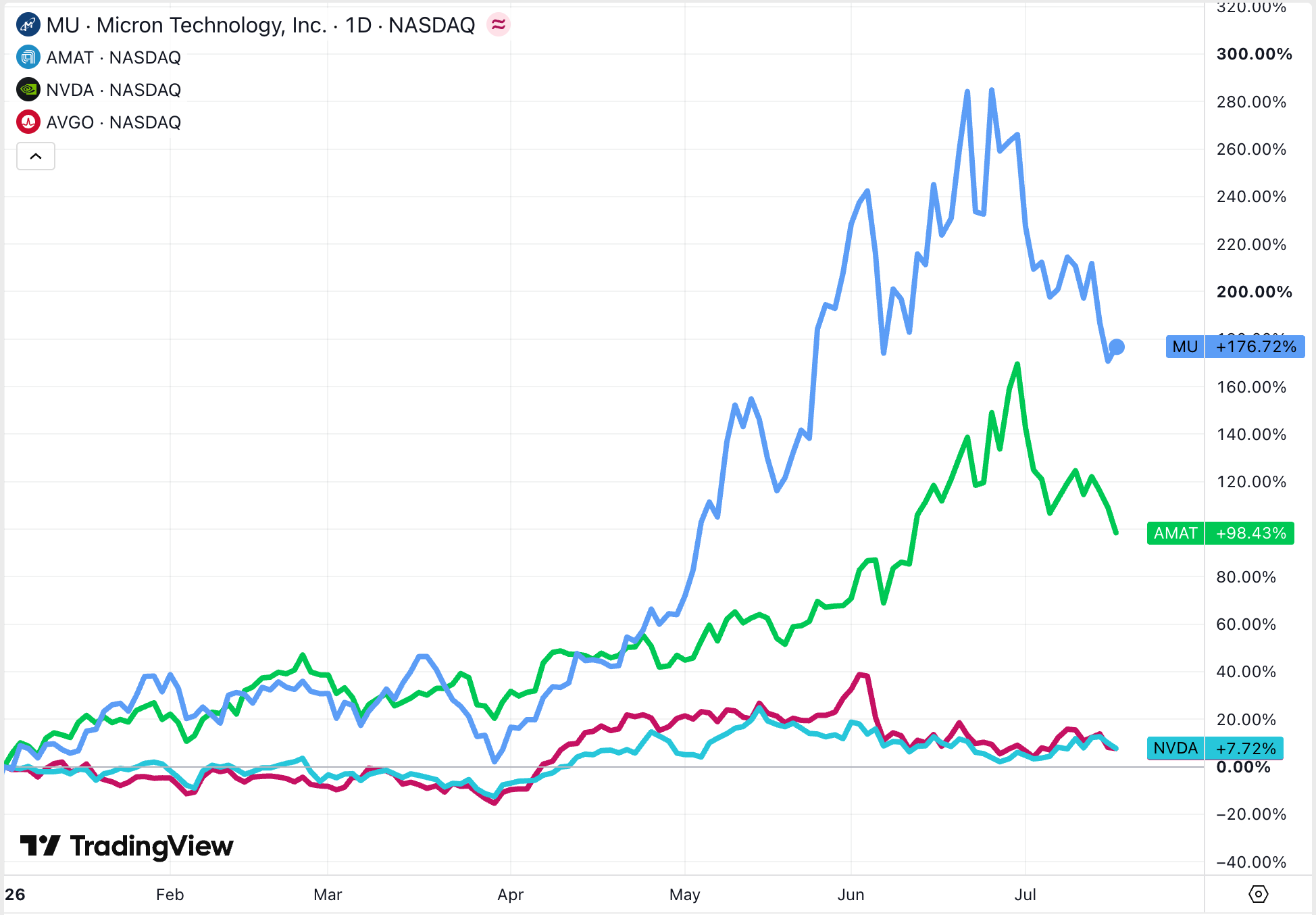
Micron (ticker: MU) and Applied Materials (ticker: AMAT) shot up like rockets in the first half of the year.
Contrast it to Nvidia and Broadcom, which are up only 8% so far.
Once July hit, investors started taking their profits with the fast-rising semiconductor stocks.
It makes sense why since those stocks became extremely overvalued.
At one point, Micron’s price-to-sales (P/S) ratio was 15x, which is more than 5x its historical average.
We know why they dropped, but why did these stocks jump so high in the first place?
Micron manufactures and sells memory chips, which experienced enormous demand because of AI.
Memory chip prices have almost quadrupled in the last year, which has made Micron a ton of money.
Applied Materials sells equipment used by Micron (which now needs more equipment to produce more memory chips), so its stock price shot up as well.
There’s a lot going on in the semiconductor industry, but what does it mean going forward?
First, valuations still matter in the stock market.
A lot of people jumped on the semiconductor bandwagon in June and they have a lot of regrets right now.
So, going forward, if an individual stock doubles or triples in price in a short period of time, take some profits and sell some shares.
And if you don’t own it yet, it’s best to stay away.
Second, the semiconductor industry is expensive, but it’s not a ripoff.
The current price-to-earnings (P/E) ratio in the industry is 42.5x, which seems high.
But its 3-year average is 39x, so its current P/E ratio is close to its historical average.
Plus, the financials in the industry are looking a lot better.
Semiconductors are carrying less debt with a current debt/equity ratio of 0.33x vs. 3-year average of 0.41x.
And semiconductors have raised their profit margins almost 10 percentage points over their historical average from 22.5% to 31%.
So if you’re looking to get into semiconductors, now is a good time.
Lastly, some industries, like semiconductors, are extremely complicated.
It can be difficult to understand, especially if you aren’t in the industry.
And determining what information is relevant or not is extremely difficult because it seems everyone is talking about it.
Which is why exchange-traded fund investing for specific industries, like semiconductors, is a great option for many of us.
Below are some of the top ETFs focused on semiconductors.
The VanEck Semiconductor ETF (ticker: SMH) is the largest semiconductor ETF managing over $70 billion in assets.
The ETF is market-cap weighted, which means the largest stocks (like Nvidia and Broadcom) take up a large part of the ETF.
If you don’t mind an ETF with a heavy concentration in the biggest semiconductor stocks, then SMH is an excellent option.
The SPDR S&P Semiconductor ETF (ticker: XSD) is another great option, especially if you think the smaller players in the industry have more room to grow.
XSD weighs its holdings equally so every stock has about a 2% weight.
So, if you think the smaller semiconductor stocks will be taking market share away from the bigger companies, then XSD is the perfect pick.
The iShares Semiconductor ETF (ticker: SOXX) invests in the 30 largest semiconductor stocks.
SOXX is a good balance between SMH and XSD.
Like SMH, the ETF is market-cap weighted, but it limits how high the concentration goes for the biggest companies.
So, large stocks like Nvidia and Broadcom are still among the biggest holdings in the ETF, but don’t dominate it like SMH.
And the smaller stocks carry a bigger size of the ETF than SMH, but not as much as XSD.
What semiconductor stocks do you own?
Coach Parker
Category: Stocks